System design
Hephaestus is one server that runs as several replicas, with PostgreSQL as its only truth. The server receives provider events, syncs the work, and runs practice reviews and conversation turns in sandboxes. A sandbox runs the agent's code. It holds no application secret, only a token for its own subject, and it reaches only the server's gateway. The server delivers feedback, Hephaestus's Slack answers, email, and product feedback issues through one outbox.
The container view also shows one decided change that main does not have yet. The text below it names it.
Runtime roles describes what runs today.
Containers and trust boundaries
This logical view shows the parts of Hephaestus that run on their own, and what each part reaches. Each arrow points from the side that opens the connection. Its label names what crosses it and the credential. A connection with no protocol in its label uses HTTPS.
«upstream» marks a part that a release deploys but does not build: the agent-sandbox controller.
Look at the sandbox. It is marked «untrusted» because it runs the agent's code. It holds a token for one subject, and it reaches only the server's sandbox gateway, on port 8081.
The server and the agent-sandbox controller never connect to each other. Both use the Kubernetes API server: the server writes a SandboxClaim, and the controller watches the claims and creates the Pods.
Helm chart reference § Where each part runs on a managed cluster shows where each part runs, and who deploys and runs it.
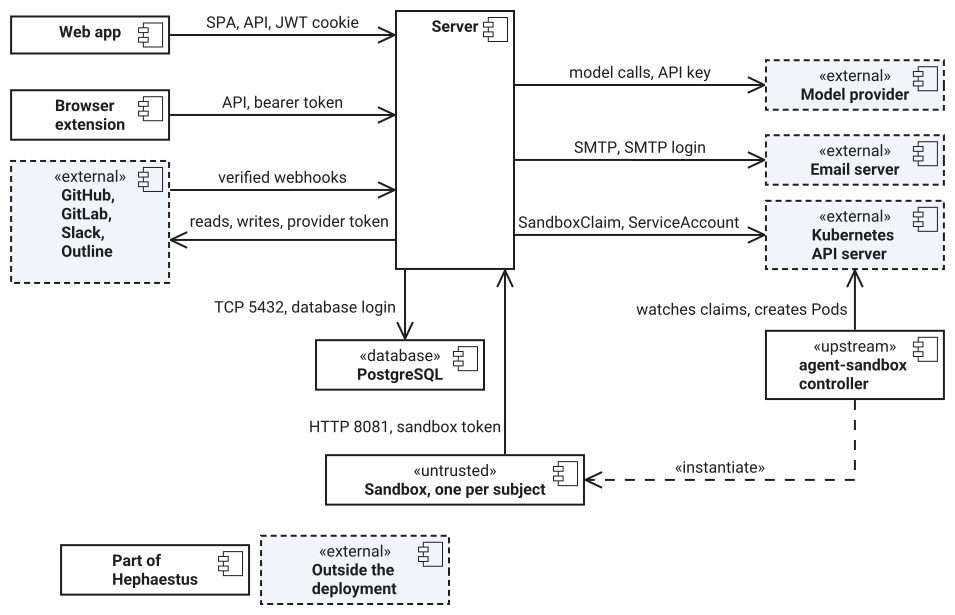
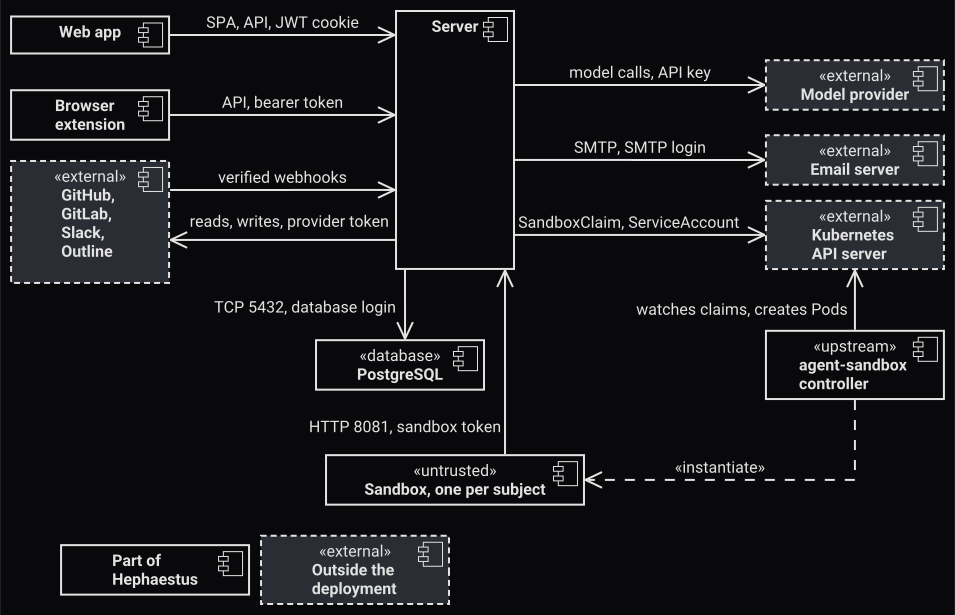
Connections as text
| From | To | What crosses, and the credential |
|---|---|---|
| Web app | Server | HTTPS: the SPA and the API, with the JWT cookie |
| Browser extension | Server | HTTPS: the API, with a bearer token |
| GitHub, GitLab, Slack, Outline | Server | HTTPS: webhooks, each verified as the next table shows |
| Server | GitHub, GitLab, Slack, Outline | HTTPS: reads and writes, with a provider token |
| Server | Model provider | HTTPS: model calls, with an API key |
| Server | Email server | SMTP, with the SMTP login |
| Server | Kubernetes API server | HTTPS: SandboxClaim writes, with the server's ServiceAccount |
| agent-sandbox controller | Kubernetes API server | HTTPS: watches the claims and creates the Pods, with the controller's ServiceAccount |
| agent-sandbox controller | Sandbox | Creates it, through the Kubernetes API server |
| Server | PostgreSQL | TCP 5432, with the database login |
| Sandbox | Server | HTTP on port 8081, with the sandbox token |
The view shows one decided change that main does not have yet. The rest of the view is on main.
The server serves the SPA (ADR 0100). Until that change lands, a webapp container with nginx serves it.
PostgreSQL notifications carry the sync-status hints to the open browsers.
| Container | What it is | Code |
|---|---|---|
| Web app | The React SPA. The server serves it, and it runs in the browser. It calls the server through the generated OpenAPI client, with the __Host-HEPHAESTUS_AT cookie (ADR 0100). | webapp/ |
| Browser extension | The Chrome extension. It signs in with PKCE and sends a bearer token (ADR 0048). | extension/ |
| Server | One JAR in one runtime role, as several replicas. It serves the SPA and owns the API, provider events, reviews, conversations, agent control, the sandbox gateway and the outbox. | server/application/ |
| PostgreSQL | The only truth. A server process or a sandbox is a cache. | server/application/src/main/resources/db/changelog/ |
| Sandbox | One agent-sandbox Sandbox for each subject, with one container: the driver, the tools and the workspace. | docker/agents/pi/, agent.sandbox |
| agent-sandbox controller | The upstream controller. It turns a SandboxClaim into a Sandbox and its Pod. | platform manifest |
Each provider verifies its webhooks in its own way. Only some of them sign the body:
| Provider | How the server verifies a webhook |
|---|---|
| GitHub | The X-Hub-Signature-256 HMAC of the body, with the app's webhook secret |
| GitLab | The route credential in X-Gitlab-Token. Its signature covers the route, not the body. |
| Slack | The X-Slack-Signature HMAC of the timestamp and the body, with the signing secret |
| Outline | The Outline-Signature HMAC of the timestamp and the body, with the webhook secret |
The server holds the application secrets: the provider tokens, the model API keys and the SMTP login. The agent-sandbox controller holds only its own ServiceAccount. A sandbox holds only its token for one subject. The agent proposes and the server acts. A sandbox cannot write to a provider or send a message. The sandbox gateway accepts a sandbox token only for the token's own subject, and only on port 8081 (ADR 0079).
Tenancy has no box of its own, because SQL enforces it.
Every workspace-owned table carries workspace_id, and every workspace endpoint is a @WorkspaceScopedController.
DataIsolationArchitectureTest checks both. Workspace context gives the rules.
Components of the server
This view opens the server box. It is a UML component diagram: it shows which part owns which work, and which interface wires two parts.
A ball is an interface that a part provides. A socket is an interface that a part requires, so the socket is on the calling side. A socket on a ball, or a dashed arrow from a socket to a ball, is one connection.
An event is an interface too: the part that listens to it provides it, and the part that publishes it requires it. A small square on the frame is a port. It passes a request from outside to the part that handles it.
Each interface carries the name of its Java type or route. "Provider SPI" is the neutral integration.core.spi package. The order of the steps is in the sequences: one review and one turn.
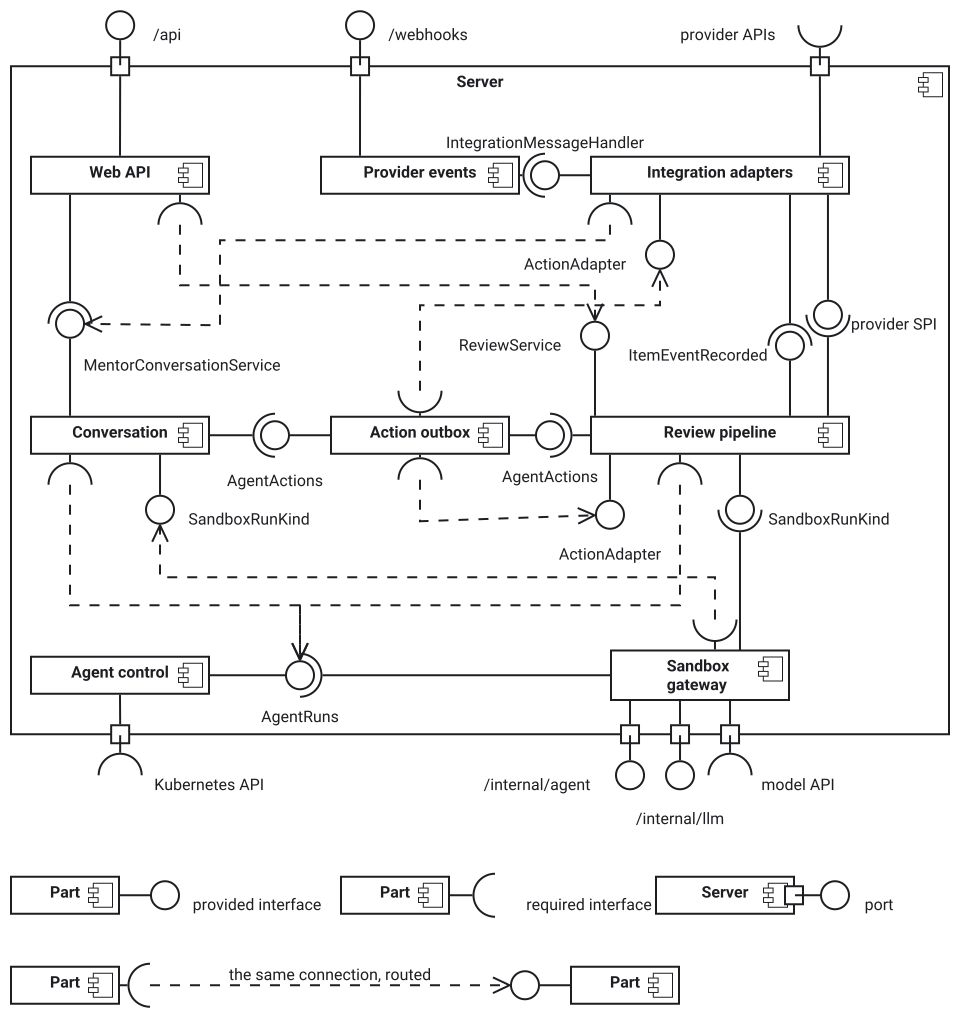
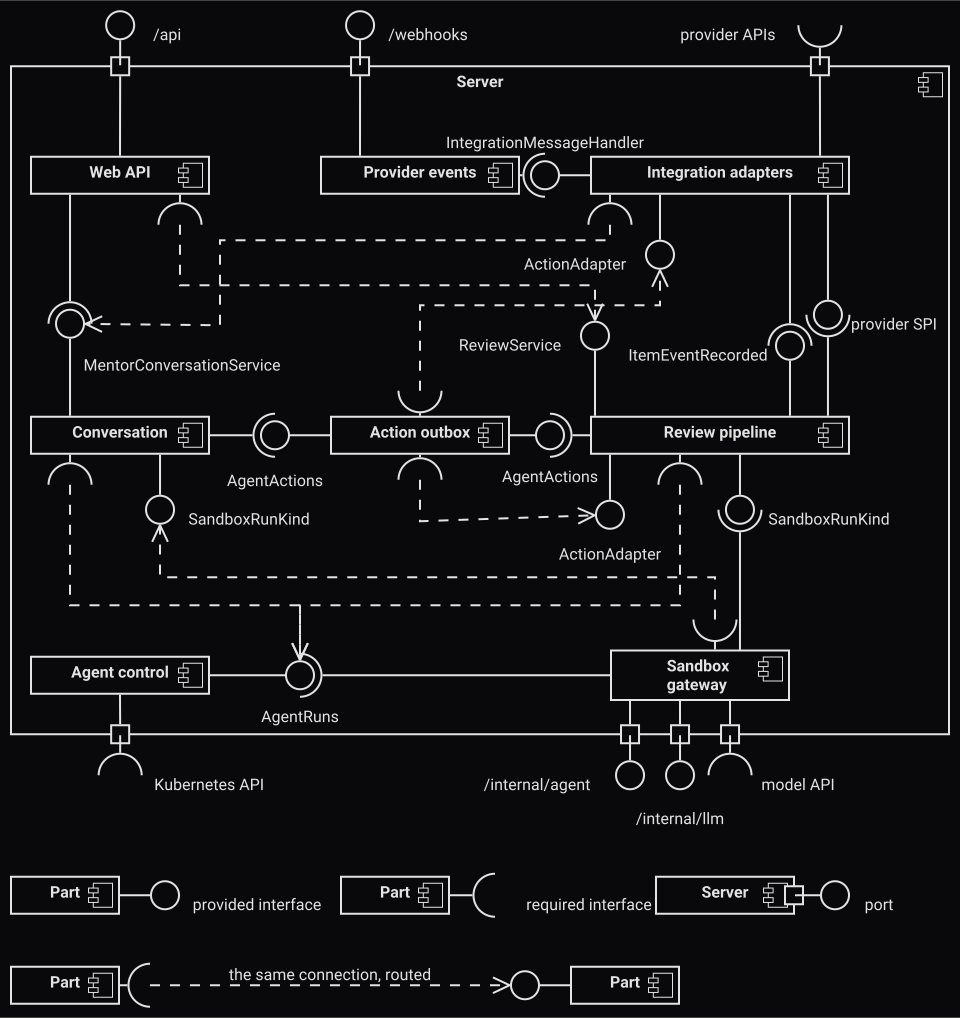
Connections as text
| Part | Requires | From |
|---|---|---|
Web API, through the port /api | MentorConversationService, ReviewService | Conversation, review pipeline |
Provider events, through the port /webhooks | IntegrationMessageHandler | Integration adapters |
| Integration adapters | MentorConversationService, ItemEventRecorded (an event that sync publishes). Provider APIs, through a port. | Conversation, review pipeline |
| Review pipeline | The provider SPI (ItemSource, SummaryWriter, LineNoteWriter), AgentActions, AgentRuns | Integration adapters, action outbox, agent control |
| Conversation | AgentActions, AgentRuns | Action outbox, agent control |
| Action outbox | ActionAdapter | Review pipeline (feedback copies), integration adapters (Slack posts) |
Sandbox gateway, through the ports /internal/agent and /internal/llm | AgentRuns, SandboxRunKind. The model API, through a port. | Agent control, review pipeline, conversation |
| Agent control | The Kubernetes API, through a port | — |
| Part | What it owns | Code |
|---|---|---|
| Web API | The /api endpoints in server/openapi.yaml, the live stream of server-sent events, and sign-in. Review requests and feedback approvals reach the review pipeline here. | each module's controllers, core.auth, agent.mentor.web |
| Provider events | The /webhooks/** endpoints, the provider_event inbox, and the event consumer that leases the oldest open event of each scope (ADR 0080). | integration.core.webhook, integration.core.consumer |
| Integration adapters | One for each provider: GitHub, GitLab, Slack and Outline. Each owns sync and implements the provider SPI: the capture reads behind ItemSource, and the feedback writes behind SummaryWriter and LineNoteWriter. Slack posts its answers behind ActionAdapter. Sync records item events and publishes ItemEventRecorded. | integration.scm, integration.slack, integration.outline |
| Review pipeline | Selection, capture, admission, composition and delivery (Practice review pipeline). It captures each item through ItemSource. Its FeedbackSendAdapter delivers each copy for the outbox and reads it back. | practices, agent.practice |
| Conversation | The conversation of each account, its turns and its digests (Conversation runtime). | mentor, agent.mentor |
| Agent control | The run queue behind AgentRuns, the sandbox of each subject and the reapers (Agent runs). It writes the SandboxClaim to the Kubernetes API. | agent.run, agent.sandbox |
| Sandbox gateway | Port 8081, for sandbox tokens only. /internal/agent serves the next run, its context, the lease, the proposals and the answer deltas. Each run kind plugs in as a SandboxRunKind. /internal/llm serves the LLM proxy, which holds the model API keys and the call permits, and the staging and sealing of review results. | agent.gateway, agent.proxy |
| Action outbox | The agent_action table behind AgentActions, and its executor: every effect on the outside world (The outbox). The view leaves out the ActionAdapter for email (EmailAdapter) and those for product feedback. | core.action, notification.email |
Every part stores its state in PostgreSQL, so the view leaves that connection out.
The view also leaves out AgentRunHandler: through it, the reaper moves a review or a turn together with its run (Agent runs).
One JAR boots in the server role, which also receives provider webhooks.
Only a server with AGENT_ENABLED runs the agent runtime: it writes sandbox claims and serves the gateway and the LLM proxy. The chart sets it from sandbox.enabled.
Without it, no review and no conversation turn runs.
Each conversation sandbox uses the same driver, run lease and gateway as review sandboxes.
Runtime roles owns role configuration, capacity, and drain behavior. Set up monitoring owns the private management listener on port 9090.
Several server replicas
Only the server role runs @Scheduled methods (ServerSchedulingConfig).
Two server replicas run each schedule on their own clock.
Every @Scheduled method therefore does one of these:
- It acts on shared state and holds a ShedLock
@SchedulerLock(JDBC, database clock,ShedLockConfig). A lock gives "never at the same time", not "once per period". SetlockAtMostForwell above the longest run andlockAtLeastForabove the clock skew between replicas. The timers of a fixed-delay job differ between replicas. Such a job must therefore tolerate a second pass in one period. - It claims or locks its rows (
FOR UPDATE SKIP LOCKED, a conditionalUPDATE, a lease), so a second pass finds no work. - It acts only on the memory, gauges or streams of its own process, so it must run on every replica.
ScheduledJobLockTest lists each unlocked job with its reason.
A new @Scheduled method fails that architecture test, in pull request CI and before a push, until it holds a lock or has a reason.
ScheduledWorkAcrossReplicasIntegrationTest checks every lock between two application contexts on one database.
Then it runs one real job while the other context holds its lock.
The scheduler is a pool of spring.task.scheduling.pool.size threads.
A long job holds one thread.
application.yml sizes the pool above the number of jobs that can run long at the same time, so the other jobs keep their schedule.
No server migrates at start: the migrate run mode migrates once per release.
Servers claim provider events from the PostgreSQL inbox with fenced leases. Events of one resource in one workspace run serially, including a replay. All GitHub installation control events share one system scope. Ingest durability owns the claim, renewal, retry and replay rules.
Work that must run one at a time on every server takes a ClusterLock (Transactions).
The chart runs two servers by default.
Module boundaries
integration adapters own provider identity, source sync, and provider-side operations. GitHub,
GitLab, Slack, and Outline each have their own adapter. A deployment syncs one configured GitLab
instance.
Additional login providers do not create additional GitLab sync instances.
Provider resource repair owns removal dispatch and adoption fencing across these adapters.
agent owns the run queue, the sandboxes, the gateway and the LLM proxy.
practices owns definitions, durable reviews, assignments, results, problems and feedback.
Core uses neutral item, capture and citation-verifier ports.
Domain modules own kind, version, role and evidence meaning.
Provider adapters own APIs, roster sync, capture and external writes.
Core imports neither provider persistence nor an SCM diff shape.
Integration modules are open. Modulith verification therefore does not enforce their persistence encapsulation. The architecture tests enforce the core, domain and provider boundary. Workspace context owns tenant enforcement.
Context map
The architecture tier generates the context map from the verified module model. CI retains it in server-context-map-<attempt> for fourteen days.
The artifact contains the overview and per-module C4 diagrams, module canvases and all-docs.adoc.
Run ./gradlew :application:architectureTest --tests '*ContextMapCoverageTest' from server/ to write the same files under application/build/spring-modulith-docs.
Do not keep a hand-drawn copy of the graph. The table below owns the relationships. Each module declaration owns its dependency list.
| Module | Responsibility | Relationship | Decision |
|---|---|---|---|
account | Account profile and sign-in views | Customer/Supplier: workspace and practice queries | ADR 0099 |
activity | Engineering activity and its public pages | Conformist: the provider-neutral SCM kernel | ADR 0099 |
agent | Review and conversation execution and admission | Customer/Supplier: practices, mentor and integration ports | ADR 0099 |
config | Shared Spring properties and executor names | Shared Kernel: technical configuration | ADR 0099 |
contributors | Contributor information | Customer/Supplier: core services | ADR 0099 |
core | Shared auth, privacy, logging, action and web contracts | Shared Kernel: platform contracts | ADR 0099 |
evidence | Captured-source and citation contracts | Shared Kernel: evidence contracts | ADR 0039 |
feature | Feature descriptors | Shared Kernel: feature names | ADR 0099 |
integration | Provider identity linking | Anticorruption Layer: provider identities to accounts | ADR 0095 |
integration.chat | Neutral conversation items | Published Language: chat item and evidence contracts | ADR 0095 |
integration.core | Connection lifecycle, inbox and integration ports | Shared Kernel: integration contracts | ADR 0095 |
integration.docs | Neutral document items | Published Language: document item and evidence contracts | ADR 0095 |
integration.outline | Outline adapter | Anticorruption Layer: Outline API to integration ports | ADR 0095 |
integration.scm | Neutral SCM model and shared mirror | Shared Kernel: SCM adapters and activity | ADR 0095 |
integration.scm.github | GitHub adapter | Anticorruption Layer: GitHub API to SCM and integration ports | ADR 0095 |
integration.scm.gitlab | GitLab adapter | Anticorruption Layer: GitLab API to SCM and integration ports | ADR 0095 |
integration.slack | Slack adapter | Anticorruption Layer: Slack API to chat and integration ports | ADR 0095 |
mentor | Conversation, entries and turn ledger | Customer/Supplier: conversation execution and delivery | ADR 0099 |
notification | Account notifications and their transports | Customer/Supplier: notification-producing domains | ADR 0044 |
observability | Structured logging and metric contracts | Shared Kernel: observability | ADR 0099 |
practices | Definitions, reviews, results and feedback | Customer/Supplier: evidence providers and execution | ADR 0099 |
productfeedback | Feedback about Hephaestus and its issue filing | Customer/Supplier: the SCM ProductFeedbackIssues port | ADR 0099 |
workspace | Tenant lifecycle and workspace policies | Customer/Supplier: product modules and provider lifecycle | ADR 0099 |
ADR 0095 permits five integration modules to stay open. Their allowed dependencies still constrain their edges. The architecture tests guard provider isolation. ADR 0099 owns the declaration and repository-ownership rules.
Existing repository accesses outside their owning module are listed with owners in RepositoryOwnershipRatchet.
Each removal must also remove its ratchet witness. A new access, stale witness or stable release with remaining debt fails the architecture check.
Sign-in
The server federates sign-in to GitHub or GitLab with Spring Security oauth2Login, then issues its own cookie-session JWT.
Slack and Outline are link-only identity providers.
ADR 0088 records the sign-in model, and Auth architecture shows the request flow.
Instance administration describes the recent-sign-in gate and the user view.
Practice reviews
Provider events wait in the PostgreSQL inbox. A server leases each event, syncs the work and records item events.
An eligible review becomes a REVIEW run in the run queue (Agent runs).
A server with AGENT_ENABLED starts the review's sandbox.
The sandbox pulls the REVIEW run through the gateway, then the REVIEW_COMPOSE run that writes the feedback.
Admission checks every result before composition and delivery, and missing required capture produces no result.
Agent runs § A review in its sandbox gives the execution and retry boundaries.
Feedback on the work waits for a workspace admin's approval by default. Delivery checks the feedback mode and silent mode again before it posts. Workspace review history gives no access to a member's private Practice profile or Hephaestus feedback (ADR 0047).
The review pipeline describes selection, capture, admission, composition and delivery. The workspace ABI describes the job folder, the capture manifest and the output contract.
Conversation
This sequence diagram shows one successful conversation turn, from a question in the app or in Slack to the answer. Look at the two streams. The model's tokens go from the model provider through the sandbox gateway to the sandbox. The answer deltas go from the sandbox to the server, and only these reach the app. Slack gets only the finished answer, through the outbox.
The sequence starts with a live sandbox. A conversation with no live sandbox gets one in the same way as a review (One review from event to feedback).
These are the parts of the turn that the arrows alone do not explain:
- Durability. A Slack event is a row in the
provider_eventinbox before Slack gets its202(Ingest durability). A question from the app is a row before the server answers. A server can stop at any step, and the next one starts again from PostgreSQL. - The fence. The lease raises the run's epoch. The gateway accepts a call on a run (
…/runs/{runId}/…) only with the current epoch. A sandbox that lost its lease cannot write. - Two streams. The LLM proxy forwards the model's tokens to the sandbox and accounts for them in the usage row. The answer that a person sees is a separate stream of deltas that the sandbox sends.
- Any replica. The server writes no row for a delta. It sends the delta to every server as PostgreSQL notification frames. Each server keeps the partial answer in memory (
MentorTurnProgress). The live hub of the server that holds the app's stream sends it on. The sandbox and the app can therefore use different server replicas. - Only the end is stored. The entries are stored once, when the turn ends. A server that misses a frame shows the partial answer again at the next whole snapshot. A whole snapshot comes at least every two seconds.
- Slack delivery. The answer for Slack is an
agent_actionrow that the outbox executes (The outbox). The executor confirms the post with the message timestamp that Slack returns. - Out of scope. This success path leaves out a stopped turn and a retry. Conversation runtime owns them.
Each turn is a TURN run in band INTERACTIVE, keyed to its conversation.
A conversation keeps one sandbox while it is in use, so a follow-up turn starts at once.
The reaper deletes the sandbox when it leased no run for conversation-sandbox-idle (15 minutes). The next question starts a new one from PostgreSQL.
PostgreSQL holds the whole conversation in three workspace-scoped tables.
The server role owns the HTTP API, the live stream, Slack ingress and posts, submission, and the schedule of the weekly digest.
A server with AGENT_ENABLED owns run admission, sandbox claims and the turn gateway endpoints.
The weekly digest is a DIGEST run in the conversation's sandbox, with the same runner, admission and fence as a turn (Agent runs § Proactive digests).
No conversation state lives in a process, so any such server serves any call of any turn.
Conversation runtime owns the turn lifecycle, its runner and the context of a turn.
The app renders the stored messages and the partial answer from the generated client.
Each account has one Conversation per workspace, with one level of threads. The app shows the whole conversation. Slack shows what was asked there.
Hephaestus is available to workspace members only, within their account-wide AI choice. It uses permitted recent work, review requests, assigned issues, the conversation itself, practices, and connected context. Conversation runtime owns how a turn delivers feedback. Ask Hephaestus owns the member-facing behavior.
Repository scans
A scan is a SCAN review, so it runs as REVIEW runs. A workspace runs one scan at a time.
It pins the default branch of a monitored repository and records which practices and files it covered.
Its report keeps the problems that it recorded and, separately, the count of problems that are still open.
After the feedback retention period, the raw proof and its exports go, and the aggregate report stays.
The scan guide describes how to run a scan and export its report.
Diagram map
Each architecture diagram answers one question. Every structural view uses one legend. Documentation guide § Structural maps in HyLiMo explains it.
| Question | View | Page |
|---|---|---|
| Who uses Hephaestus, and what does it connect to? | System context | Admin overview |
| What runs, and what may each part reach? | Containers and trust boundaries | Containers and trust boundaries |
| Where does each part run on a cluster, and who deploys and runs it? | Deployment | Helm chart reference |
| Which part of the server owns which work? | Components of the server | Components of the server |
| Where can a review stop, and why? | Review stages | Practice review pipeline |
| Who calls whom during one review? | Review sequence | Practice review pipeline |
| How does one answer reach the app or Slack? | Turn sequence | Conversation |
| How does a run move between states? | agent_run lifecycle | Agent runs |
| How do the review records relate? | Core data model | Practice review glossary |
Sync-status hints across replicas
A committed sync change sends only its workspace ID, connection ID and scope token through PostgreSQL NOTIFY.
Each server listens on sync_status and delivers received hints to its local SSE subscribers, including on the origin server.
The client reads the state through REST. It also polls, so a notification lost during reconnect does not hide the state.
The listener owns a dedicated connection and reconnect loop, as the ledger, run, evidence and permit listeners do. It cannot hold up their dispatch. The chart connection budget includes all five listeners for every server in rolling overlap.